York rooftop units (RTUs) are widely installed commercial HVAC systems across North America, serving retail centers, schools, warehouses, office buildings, and light industrial facilities. Every York economizer — the outside air intake section that enables free cooling when outdoor temperatures allow — requires a dedicated aluminum mesh pre-filter to protect the unit from airborne debris, insects, cottonwood, coarse particulate, and pollen. When that filter becomes permanently clogged or is left unmaintained, the economizer damper, heat exchanger coil, and all downstream high-efficiency filters are exposed to unfiltered outdoor air, accelerating wear and increasing repair costs.
Metal Air Filters manufactures precision-cut, washable aluminum mesh replacements for every York economizer filter in current and legacy production. Our filters match or exceed the original York OEM specifications across the entire S1-026-XXXXX-000 service part number family, covering all standard and exact-dimension economizer filter configurations used across York’s Predator, Sunline, and large commercial packaged RTU lines. Each filter is made in the USA, UL 900 Class 1 rated for continuous service up to 275°F, and built to last 5 to 10 years with routine cleaning. Select your OEM replacement by part number or filter size using the product grid below, or use the compatibility tables further down the page to match your specific York rooftop unit model.
York Washable Filter — Shop by OEM Part Number
-
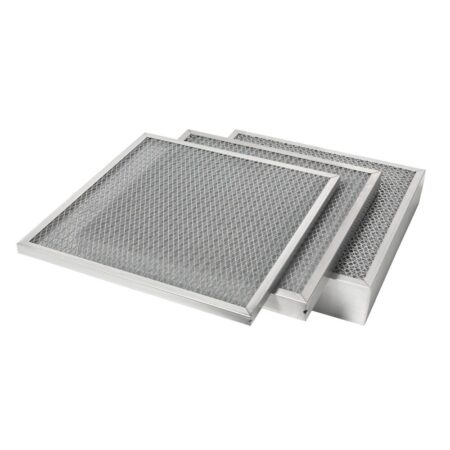
YORK S1-026-08210-000 Compatible Aluminum Mesh Filter, 16x25x1
$42.27L: 15.5in, W: 24.5in, H: 0.875inAdd to cart -
YORK S1-026-25514-000 Compatible Aluminum Mesh Filter, 14x20x1
$34.76L: 13.5in, W: 19.5in, H: 0.875inAdd to cart -
YORK S1-026-25535-000 Compatible Aluminum Mesh Filter, 23-1/8×24-5/8×1 Exact
$78.60L: 23.125in, W: 24.625in, H: 0.875inAdd to cart -
YORK S1-026-25557-000 Compatible Aluminum Mesh Filter, 32-1/4x36x1 Exact
$144.95L: 32.25in, W: 36in, H: 0.875inAdd to cart -
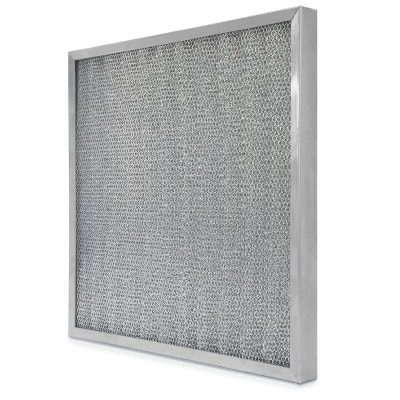
YORK S1-026-25572-000 Compatible Aluminum Mesh Filter, 21-1/4x36x1 Exact
$92.13L: 21.25in, W: 36in, H: 0.875inAdd to cart -
YORK S1-026-38061-000 Compatible Aluminum Mesh Filter, 22×30-1/4×1 Exact
$90.26L: 22in, W: 30.25in, H: 0.875inAdd to cart -
YORK S1-026-42507-000 Compatible Aluminum Mesh Filter, 28×32-1/4×2 Exact
$190.77L: 28in, W: 32.25in, H: 1.75inAdd to cart
Product Overview — What Are York Economizer Pre-Filters?
York economizers are outside air (OA) intake modules integrated into commercial rooftop units. They allow the HVAC system to draw in cool outdoor air during mild weather, reducing mechanical cooling load and cutting energy costs during shoulder seasons — a process called free cooling or economizer mode. The pre-filter, an aluminum mesh screen mounted directly in the intake louver or dedicated filter track, is the first and only filtration layer between the outdoor environment and the unit’s interior components. It captures large and medium-size particles — pollen, cottonwood seed, insects, leaves, and coarse dust — before they reach the coil, the downstream pleated filters, or the economizer damper blade.
Unlike the disposable filters installed downstream, the economizer pre-filter is designed to be a permanent component. It is a structural and filtration element simultaneously. York’s OEM specification calls for corrugated aluminum mesh media that captures particulate while maintaining a low resistance to airflow across the face. Low pressure drop is critical in high-airflow rooftop applications because any restriction directly increases fan motor load and reduces the volume of supply air delivered to the building below.
Our replacement filters use the same multi-ply corrugated aluminum media construction as the York OEM specification. The media is formed from aluminum alloy corrugated sheet stock, stacked in 5 plies (1” depth) or 7 plies (2” depth), and bonded between two rigid aluminum face grids. Those grids keep the media tightly packed throughout the service life and prevent deformation at high face velocities — a common failure mode in lower-quality aftermarket alternatives fabricated with looser tolerances. The outer frame is .030” nominal wall aluminum alloy, mitered and pop-riveted at the corners to maintain dimensional accuracy to ±1/16” and resist the corrosive outdoor environment of a rooftop installation.
York economizer filters are predominantly exact-dimension configurations. Unlike Trane’s AG0320xxx family or Carrier’s KH03DU series — which standardized a small set of nominal sizes across their full RTU product line — York’s S1-026 service part number family covers a wider range of filter dimensions, each tied to a specific economizer section geometry. This means the OEM part number stamped on the existing filter frame is particularly important when ordering a York replacement — do not assume a nominal size match without confirming by part number. Both 1” and 2” depth configurations exist in the York catalog; the 2” depth S1-026-42507-000 (28×32-1/4) provides doubled media capacity for higher-dust-loading applications.
Technical Specifications
All York-compatible aluminum mesh filters manufactured by Metal Air Filters conform to the following specifications. Values apply to both 1” and 2” depth configurations unless noted.
| Specification | Value |
|---|---|
| Media material | Multi-ply corrugated aluminum alloy mesh |
| Media plies — 1” depth | 5-ply corrugated construction |
| Media plies — 2” depth | 7-ply corrugated construction |
| Face grid material | Aluminum alloy, bonded both sides |
| Frame material | Aluminum alloy, .030” nominal wall |
| Frame construction | Mitered corners, pop-riveted |
| Dimensional tolerance | ±1/16” on all face dimensions |
| UL rating | UL 900 Class 1 |
| Maximum continuous temperature | 275°F (135°C) |
| Dust arrestance (ASHRAE 52.1) | 43% (1” depth) / 53% (2” depth) |
| Dust holding capacity — 1” | 68 g/sq ft |
| Dust holding capacity — 2” | 97 g/sq ft |
| Recommended service interval | 60–90 days (standard installations) |
| Service life | 5–10 years with regular cleaning |
| Country of manufacture | USA (Metal Air Filters, since 1986) |
York OEM Part Number Reference — All Compatible Filters
York economizer filters use the S1-026-XXXXX-000 service part number convention: “S1” denotes a service replacement component, “026” is York’s internal category code for economizer pre-filters, the five-digit numeric string identifies the specific size and configuration, and “000” indicates the base revision. All York economizer filters in the S1-026 family are exact-dimension configurations — the face dimensions are specific to the unit’s economizer inlet geometry and are not interchangeable across filter sizes. The table below maps each York OEM part number to our direct replacement, confirming exact face dimensions and our catalog SKU.
| York OEM Part # | Size (W×H) | Depth | Our SKU | Shop |
|---|---|---|---|---|
| S1-026-08210-000 | 16 × 25 | 1” | HIA101625-1-S1-026-08210-000 | Shop → |
| S1-026-25514-000 | 14 × 20 | 1” | HIA101420-1-S1-026-25514-000 | Shop → |
| S1-026-25535-000 | 23-1/8 × 24-5/8 | 1” | HIAS100600-1-S1-026-25557-000 | Shop → |
| S1-026-25557-000 | 32-1/4 × 36 | 1” | HIAS101250-1-S1-026-25557-000 | Shop → |
| S1-026-25572-000 | 21-1/4 × 36 | 1” | HIAS100800-1-S1-026-25572-000 | Shop → |
| S1-026-38061-000 | 22 × 30-1/4 | 1” | HIAS100700-1-S1-026-38061-000 | Shop → |
| S1-026-42507-000 | 28 × 32-1/4 | 2” | HIAS200950-1-S1-026-42507-000 | Shop → |
Not seeing your part number? We manufacture custom-cut filters to exact dimensions — browse our custom filter options or contact us with your filter’s face measurements and depth and we will fabricate to specification.
Finding Your York Economizer Filter Part Number
Before ordering, confirm the replacement filter part number using one of three reliable methods. Because York S1-026 filters are exact-dimension configurations — not interchangeable nominal sizes — getting the correct part number is especially important: a filter that is even 1/4” too wide or too tall will not seat properly in the track.
Method 1 — Read the Existing Filter Frame
The OEM part number is typically stamped into the aluminum frame rail or printed on a label adhered to one of the four sides of the filter frame. Look for the S1-026-XXXXX-000 format. If the label is worn, the stamping usually remains readable after wiping with a clean cloth. Write down the full part number including the “S1-026” prefix and the three trailing zeros — these are required to match the correct catalog entry.
Method 2 — Check the Unit Service Label
Many York and Johnson Controls RTUs include a service or startup label affixed inside the outside-air (OA) access panel door or on the interior unit cabinet adjacent to the filter track. This label often lists the required economizer filter part number and the nominal filter size in parentheses. On York Predator series units, this label is frequently on the inside face of the OA access door. On larger commercial models (ZJ, ZF, and related series), check the unit data plate mounted to the main cabinet.
Method 3 — Measure the Filter Track Opening
If the existing filter is missing and no service documentation is available, measure the filter track opening directly: width × height × depth to the nearest 1/16”. Cross-reference these measurements against the OEM Part Number table above to identify the correct part number. Because all York S1-026 filters are exact-dimension, this measurement approach is highly reliable as long as measurements are taken carefully from the actual track walls and not from a worn or deformed opening. The compatible models table in the next section can also narrow the search by model series and tonnage once the unit is identified.
Compatible York Rooftop Unit Models
York economizer filter part numbers span a broad range of commercial RTU configurations produced across four decades. All York S1-026 filters are exact-dimension specifications, so a given filter part number is tied to the specific economizer inlet geometry of its corresponding model series. The table below maps each major York and Johnson Controls RTU family to its typical filter part number(s). Always confirm by part number label or track measurement before ordering.
| Model Series | Brand | Typical Tonnage | Common Filter Part Numbers |
|---|---|---|---|
| Predator YD / YC (compact) | York / JCI | 2–7.5 ton | S1-026-25514-000 (14×20), S1-026-08210-000 (16×25) |
| Predator YD / YC (mid-range) | York / JCI | 7.5–20 ton | S1-026-25535-000 (23-1/8×24-5/8), S1-026-38061-000 (22×30-1/4) |
| Predator YD / YC (large) | York / JCI | 20–30 ton | S1-026-25572-000 (21-1/4×36), S1-026-25557-000 (32-1/4×36) |
| Sunline 2000 Commercial | York / JCI | 5–25 ton | Verify by unit label |
| ZJ / ZF Commercial Packaged | York / JCI | 25–50 ton | S1-026-42507-000 (28×32-1/4×2”), S1-026-25557-000 (32-1/4×36) |
| Legacy commercial RTUs (pre-2006) | York | Various | Verify by unit label or track measurement |
Because York uses unique filter dimensions for many of its RTU configurations, size consolidation across a mixed fleet is less common than with Trane or Carrier. A facility with multiple York RTUs of different tonnages should expect to maintain separate replacement filter inventory for each unit family. The part number on each unit’s existing filter frame remains the most reliable procurement reference.
Note on Johnson Controls (JCI) and Luxaire compatibility: Following Johnson Controls’ acquisition of York International in 2005, York commercial RTUs continued to be manufactured and sold under the York brand name with unchanged part number schemes. Johnson Controls also markets commercial HVAC equipment under the Luxaire brand for the residential and light-commercial market. If your unit bears a Johnson Controls or Luxaire nameplate and specifies an S1-026-prefix filter part number, our replacement is the correct direct fit.
About York — 150 Years of American HVAC Innovation
York’s story begins in 1874 in York, Pennsylvania, where the York Manufacturing Company was founded to produce ice-making machinery for the growing cold-storage and food preservation industries. In an era before reliable mechanical refrigeration was widely available, the ability to manufacture ice on demand was commercially transformative, and York established itself as a premier supplier of refrigeration equipment for breweries, meatpacking plants, and cold-storage warehouses across the eastern United States. The engineering competency York developed in mechanical refrigeration — compressors, heat exchangers, expansion devices — formed the technical foundation for everything the company would build in the 20th century.
The transition from industrial refrigeration to commercial air conditioning began in earnest during the 1920s and 1930s, as other pioneers in the field (including Willis Carrier) demonstrated that the same refrigeration principles used for food storage could be applied to the control of building environments. York was among the early manufacturers of commercial chiller systems and packaged cooling equipment for large public buildings, department stores, and commercial office spaces. By the mid-20th century, York had built a substantial commercial HVAC business alongside its legacy refrigeration operations, serving building owners and HVAC contractors across North America and internationally.
York International Corporation, the public company that operated the York brand in the modern era, grew through acquisitions and international expansion to become one of the four dominant commercial HVAC manufacturers in the world alongside Carrier, Trane, and Lennox. The company’s commercial rooftop unit portfolio — the Predator and Sunline series in particular — became standard fare for mid-size commercial construction projects across North America, with the S1-026-prefix economizer filter part numbers introduced as the standardized service replacement scheme for the company’s packaged RTU product line across its full range of inlet geometries. That scheme, with its exact-dimension approach, reflects York’s engineering philosophy of matching filter performance precisely to each unit’s economizer section rather than standardizing across a common nominal size.
In December 2005, Johnson Controls acquired York International Corporation for approximately $3.2 billion, adding the York brand to a portfolio that already included Metasys building automation systems, York-branded chillers, and a global HVAC service business. The acquisition made Johnson Controls one of the largest HVAC companies in the world. Under JCI ownership, the York brand name was retained for commercial products, and the S1-026 service part number family continued unchanged through successive generations of York commercial RTU production. The residential and light-commercial York business was expanded alongside the Luxaire brand (sold through independent distributors) and the Coleman HVAC brand (sold through Wesco distributors). In 2016, Johnson Controls merged with Tyco International to form a combined building technologies and security company, trading on the New York Stock Exchange under the ticker JCI.
Today Johnson Controls operates the York brand across a comprehensive commercial HVAC portfolio. The packaged rooftop unit line spans the Predator YD / YC series (2–30 ton commercial cooling and heat pump RTUs), the Sunline 2000 commercial series, and the ZJ / ZF commercial packaged units for large-tonnage applications. Central-plant equipment includes the York YZ and York YK centrifugal chillers, the York YVAA air-cooled screw chiller series, and the York YLAA air-cooled scroll chiller line. For variable refrigerant flow (VRF) applications, JCI markets the York VRF system under the York brand. Building automation is handled by Johnson Controls’ Metasys platform, which integrates York equipment with other building systems for centralized energy management. The York DOAS (Dedicated Outdoor Air System) line addresses the growing market for energy-recovery ventilation in high-performance buildings. Despite this broad portfolio, the packaged rooftop unit remains the highest-volume commercial product, with the S1-026 economizer filter part numbers serving an installed base of York RTUs that spans more than 40 years of production.
Installation Instructions
Installing a replacement York economizer pre-filter is a routine maintenance task that does not require specialized tools or HVAC certifications. Total installation time is typically 10 to 15 minutes per unit, including access panel removal and filter track inspection. The steps below apply to the majority of York and Johnson Controls commercial RTUs equipped with single-piece filter track economizer sections.
Before You Begin
- Confirm the replacement filter dimensions match the existing filter, or verify the OEM part number against the reference table above. York S1-026 filters are exact-dimension — even a small dimensional mismatch will prevent proper seating.
- Follow all jobsite safety protocols for rooftop access, including fall protection appropriate to roof type and parapet height.
- Power down the unit at the main disconnect switch or set the thermostat to off before opening the access panel.
- Have a clean cloth or soft brush available for track cleaning.
Step-by-Step Filter Replacement
- Access the economizer section by opening the outside air intake access panel. On most York Predator and Sunline units this panel is on the front face of the unit (the side designated for outdoor air intake) and is secured with ¼-turn Dzus fasteners or hex-head screws. A flat-blade screwdriver, Dzus tool, or hex driver is typically required. Consult the unit’s IOM document if the access panel location is not immediately apparent.
- Remove the existing filter by gripping the filter frame on both sides and pulling straight out of the filter track. On units equipped with retaining wire clips or a hold-down bar, release those fasteners before pulling. Do not force the filter; if resistance is felt, check for additional fasteners or obstructions.
- Inspect and clean the filter track. Use a brush or cloth to clear accumulated debris from the four track walls. Inspect for bent sections, corrosion, or gaps that would allow air to bypass the filter face. Any significant track deformation should be corrected before installing the new filter to ensure a bypass-free seal.
- Slide the new filter into the track with the corrugated media face oriented toward incoming airflow — corrugation rows face the outside of the unit, the flatter face toward the interior. On units with a directional filter track slot, the filter will seat correctly in only one orientation.
- Confirm full seating. The filter frame should sit flush with the four track walls on all sides. Any gap creates an unfiltered air bypass that defeats the purpose of the pre-filter entirely. Because York filters are exact-dimension, a correctly sized filter that is properly oriented should seat flush without forcing.
- Re-engage all retaining fasteners. Replace hold-down bars, retaining clips, or securing screws as applicable. Close and secure the access panel.
- Restore power and verify normal operation. With the unit back online, confirm that the economizer damper cycles normally. An improperly seated filter with excessive frame interference can restrict damper travel in units where the filter track and damper assembly are closely toleranced.
Model-Specific Access Notes
- Predator YD / YC compact (2–7.5 ton): OA access panel is typically on the front face, secured with two Dzus ¼-turn fasteners. The filter (S1-026-25514-000 or S1-026-08210-000) slides into a horizontal track just inside the panel. These units are compact and the filter is lightweight — a single-person job in most conditions. Check for a retaining clip before attempting to pull the filter.
- Predator YD / YC mid-range (7.5–20 ton): Same general access design as the compact Predator series, with a taller economizer section. The S1-026-25535-000 (23-1/8×24-5/8) and S1-026-38061-000 (22×30-1/4) filters are medium-weight and typically a single-person job, though the taller access panel may require ladder positioning before attempting the pull.
- Predator YD / YC large (20–30 ton): The S1-026-25572-000 (21-1/4×36) and S1-026-25557-000 (32-1/4×36) filters are large and moderately heavy. Two-person handling is recommended for the 32-1/4×36 filter in particular. Access panels on larger Predator units may be secured with multiple fasteners — inspect all four sides of the panel perimeter before pulling.
- ZJ / ZF Commercial Packaged (25–50 ton): These large-tonnage commercial units have substantially larger access panels and economizer sections. The S1-026-42507-000 (28×32-1/4×2”) 2-inch depth filter is the heaviest filter in the York catalog — two-person handling and appropriate lift equipment are required for safe rooftop service. Set up all access equipment before opening the panel. Confirm the filter track is clear and undamaged before inserting the new filter; the 2” depth track depth must be unobstructed for the thicker filter frame to seat fully.
- Sunline 2000 Commercial: Access procedure varies by unit generation and tonnage. Consult the unit’s installation, operation, and maintenance (IOM) document for panel location and fastener type. Sunline 2000 units that use the standard S1-026 filter family follow the same track-and-slide installation procedure as the Predator series.
- Johnson Controls / Luxaire branded units: If the unit bears a Johnson Controls or Luxaire nameplate but specifies an S1-026-prefix filter, the economizer section and access procedure are identical to the corresponding York-branded unit.
Cleaning and Maintenance
Washable aluminum mesh filters are designed to be cleaned and reinstalled rather than discarded, making them both more economical and more environmentally sustainable than disposable alternatives over a multi-year maintenance program. Regular cleaning prevents the filter from reaching the point where pressure differential across a fully loaded media pack is large enough to deform the corrugated layers or push air around the frame seal.
Recommended Cleaning Frequency
A 60 to 90 day interval is a reasonable starting point for standard commercial rooftop installations. Adjust based on site conditions:
- High-particulate sites (highways, agricultural operations, construction zones, heavy vehicular traffic): inspect monthly, clean every 30–60 days.
- Cottonwood or heavy pollen seasons: inspect weekly during peak season. Cottonwood loading can fully block an aluminum mesh filter in 2–3 weeks in affected climates.
- Coastal installations: rinse with fresh water every 60 days to remove salt accumulation even when the filter is not otherwise visibly dirty.
- Low-particulate urban or suburban sites: 90-day intervals are typically sufficient.
Cleaning Procedure
- Remove the filter from the unit (reverse of installation sequence). Cleaning in place is not recommended as it directs wash water into the economizer section and may wet downstream filters or the coil face.
- Transport to a suitable cleaning area with hose access or a drain. For high-rise units without rooftop hose access, a wet/dry vacuum handles dry debris removal as an alternative.
- Rinse with a garden hose or pressure washer on low setting, directing water countercurrent to the original airflow direction — in through the back of the filter, out through the face — to dislodge captured particles rather than driving them deeper into the media layers.
- For heavy fouling (cottonwood packing, grease-laden intake air, industrial environments): apply a mild detergent or degreaser diluted per the product label, allow a 5-minute dwell, then rinse thoroughly in both directions until rinse water runs clear.
- Shake excess water from the filter and inspect the frame and media for damage before reinstalling. Look for bent sections, separated corner miters, or media deformation that would create gaps.
- Allow to air-dry before reinstalling if ambient temperatures are at or below freezing. In warmer conditions, installing a wet filter is acceptable — the unit’s airflow completes the drying within minutes.
When to replace rather than clean: Retire the filter when the aluminum frame shows through-corrosion (pinholes or cracks), when a corner miter has separated beyond re-squaring, or when the media has been physically deformed in a way that creates a persistent bypass gap in the filter track. A filter that still seals cleanly and whose media is physically intact can continue to be cleaned and reinstalled indefinitely within the 5–10 year service life guideline.
Frequently Asked Questions
Are these direct OEM replacements for the original York filters?
Yes. Each filter is manufactured to match the exact dimensional specification of the corresponding York S1-026 OEM part number, including face dimensions, media depth, and frame wall thickness. Our filters are aftermarket replacements made in the USA by Metal Air Filters and do not carry the York or Johnson Controls brand name, but dimensional and performance compatibility with the OEM specification is confirmed for every part number listed on this page. The UL 900 Class 1 rating and dust arrestance figures are equivalent to or exceed the original specification.
What does the S1-026-XXXXX-000 part number format mean?
York’s S1-026 part number convention breaks down as follows: S1 designates a service/replacement component (as opposed to a factory-installed production part); 026 is York’s internal commodity code for economizer pre-filters; the five-digit numeric string (e.g., 08210, 25514) identifies the specific size and configuration within the filter family; and 000 designates the base revision level. When one of these digits changes, it typically indicates a dimensional or material revision to the part — always order by the full part number to ensure you receive the correct size for your unit.
Do these filters fit Johnson Controls or Luxaire branded units?
Yes. Following Johnson Controls’ acquisition of York International in 2005, York commercial RTUs continued to use the same S1-026-prefix part numbers under the York brand. Johnson Controls also markets commercial and residential HVAC equipment under the Luxaire brand name. If your unit bears a Johnson Controls or Luxaire nameplate and the service documentation or filter frame label specifies an S1-026-prefix filter, our replacement is the correct direct fit.
How long will a York washable aluminum mesh filter last?
Under normal maintenance conditions — cleaning every 60 to 90 days and frame inspection at each cleaning — these filters deliver a 5 to 10 year service life. The corrugated aluminum media does not degrade from repeated washing or long-term outdoor exposure, and the all-aluminum frame resists typical rooftop corrosion. Retire the filter when the frame shows through-corrosion, a corner joint has separated irreparably, or the media has been physically deformed in a way that creates a persistent bypass gap.
What if my York unit requires a non-standard filter size?
Metal Air Filters manufactures custom-cut aluminum mesh filters to exact face dimensions and depth specifications. If your economizer requires a size not shown in our standard catalog — including fractional-dimension filters and sizes larger than our listed stock — contact us with the exact face measurements (height × width × depth to the nearest 1/16”) and we will fabricate to specification from the same UL 900 Class 1 rated materials used in our standard catalog products. Browse our custom filter options for reference.
Can I wash the filter while it is still installed in the unit?
We recommend removing the filter for cleaning rather than washing it in place. In-place washing directs water into the economizer section, potentially wetting the downstream pleated or MERV-rated filters and the coil face. Wet downstream filters can collapse or lose structural integrity, and wetting an evaporator coil in freezing conditions can cause ice formation that damages the aluminum fins. Filter removal adds roughly 5 minutes to the process and allows for thorough rinsing from both sides, complete inspection, and proper drying assessment before reinstallation.
Are these filters rated for continuous outdoor exposure?
Yes. The corrugated aluminum media and aluminum alloy frame are both specified for outdoor service as required by the rooftop economizer application. The UL 900 Class 1 rating confirms flame-spread characteristics appropriate for air-handling applications, and the 275°F continuous temperature rating far exceeds any temperature encountered in a rooftop economizer intake under normal operating conditions. In severe coastal or industrial chemical environments, inspect the frame more frequently for accelerated corrosion and plan for replacement at the lower end of the 5–10 year service life guideline.
Do these filters work in York heat pump packaged units?
Yes. York and Johnson Controls offer heat pump variants of the Predator YD / YC series and other commercial packaged RTU lines. These heat pump units use the same economizer section and filter track geometry as their cooling-only counterparts. The required S1-026-prefix filter part number is determined by the unit’s economizer inlet dimensions, which are the same regardless of whether the unit provides cooling only or heating and cooling via a heat pump refrigeration circuit. Identify your replacement by the OEM part number on the existing filter frame or the unit’s service label, then select from the reference table above.
Why are York economizer filters all exact-dimension instead of standard nominal sizes?
York engineered its commercial RTU product line with economizer inlet dimensions matched precisely to the aerodynamic and structural requirements of each specific unit configuration, rather than standardizing around a common nominal filter size used across multiple tonnage classes. This approach optimizes airflow resistance and filter face velocity for each unit but results in a broader range of filter part numbers compared to Trane’s AG0320xxx or Carrier’s KH03DU family, which consolidated multiple unit sizes into a small set of common filter dimensions. The practical implication for facility managers is that York filter procurement requires tighter part number management — but the payoff is a filter whose face area and depth are optimized for the specific unit it protects.
Metal Air Filters has been manufacturing washable aluminum mesh filters in the USA since 1986. Our direct-from-manufacturer model eliminates distributor markup and ensures the correct filter ships to your door, whether you need a single replacement or a bulk order covering a multi-building portfolio of York and Johnson Controls RTUs. All orders over $99 ship free. Custom filter fabrication is available for non-standard sizes — contact us with your face dimensions and depth and we will have a quote back to you the same business day.