Washable metal furnace filters are permanent, reusable aluminum mesh filters designed to fit the standard 1” return air filter slot in residential and light-commercial forced-air heating and cooling systems. Where a disposable fiberglass or pleated filter is thrown away every 30 to 90 days, a washable metal filter is rinsed, dried, and reinstalled — delivering the same coarse-particulate protection year after year without recurring replacement costs. Metal Air Filters has manufactured washable aluminum mesh furnace filters in the USA since 1986, in every standard nominal size from 12×24 through 24×24 and beyond.
Our HI Series washable aluminum mesh furnace filters use a multi-ply corrugated aluminum media pack bonded between rigid face grids inside a mitered, pop-riveted aluminum frame. The construction is identical to the filters used in commercial HVAC economizers — the same alloy, the same media specification, the same UL 900 Class 1 rating — sized and priced for residential and light-commercial retrofit. Available in 1” depth for standard return air filter slots and 2” depth for thicker-filter applications. All orders over $99 ship free.
Shop Washable Metal Furnace Filters — Standard Nominal Sizes
-
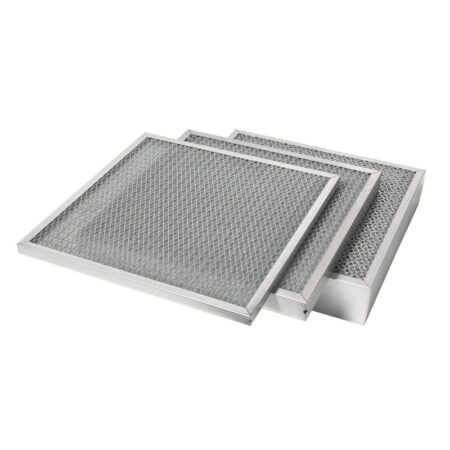
16x20x1 Washable Aluminum Mesh Filter
$38.28L: 15.5in, W: 19.5in, H: 0.875inAdd to cart -
16x20x2 Washable Aluminum Mesh Filter
$54.54L: 15.5in, W: 19.5in, H: 1.75inAdd to cart -
16x25x1 Washable Aluminum Mesh Filter
$42.45L: 15.5in, W: 24.5in, H: 0.875inAdd to cart -
16x25x2 Washable Aluminum Mesh Filter
$61.45L: 15.5in, W: 24.5in, H: 1.75inAdd to cart -
20x20x1 Washable Aluminum Mesh Filter
$42.33L: 19.5in, W: 19.5in, H: 0.875inAdd to cart -
20x20x2 Washable Aluminum Mesh Filter
$61.34L: 19.5in, W: 19.5in, H: 1.75inAdd to cart -
20x24x1 Washable Aluminum Mesh Filter
$47.35L: 19.5in, W: 24.5in, H: 0.875inAdd to cart -
20x24x2 Washable Aluminum Mesh Filter
$64.79L: 19.5in, W: 23.5in, H: 1.75inAdd to cart -
20x25x1 Washable Aluminum Mesh Filter
$47.35L: 19.5in, W: 24.5in, H: 0.875inAdd to cart -
20x25x2 Washable Aluminum Mesh Filter
$69.29L: 19.5in, W: 24.5in, H: 1.75inAdd to cart -
24x24x1 Washable Aluminum Mesh Filter
$51.10L: 23.5in, W: 23.5in, H: 0.875inAdd to cart -
24x24x2 Washable Aluminum Mesh Filter
$75.94L: 23.5in, W: 23.5in, H: 1.75inAdd to cart
Product Overview — What Is a Washable Metal Furnace Filter?
A washable metal furnace filter performs the same job as a disposable filter: it protects the blower motor, evaporator coil, and heat exchanger of your forced-air system from the airborne particulate — dust, pet dander, lint, pollen, and coarse debris — that a return air system draws in from living spaces and equipment rooms. The difference is construction. A disposable filter uses a fiber media pad that captures particles through interception and diffusion until it is loaded, then gets discarded. A washable metal filter uses corrugated aluminum mesh media that captures coarse particles by inertial impaction, can be rinsed clean in minutes, and then returns to service.
The trade-off is filtration efficiency versus longevity. A metal mesh filter is not a high-MERV filter — it does not capture fine particles (PM2.5, bacteria, smoke) the way a MERV 11 or MERV 13 pleated filter does. Its dust arrestance is in the MERV 4 to MERV 5 range: sufficient to protect HVAC equipment from the coarse particulate that causes blower imbalance, coil fouling, and heat exchanger contamination, while maintaining very low airflow resistance across the media. For occupants who rely on air filtration for allergy or health protection, a metal mesh pre-filter is best paired with a higher-rated downstream filter. For equipment protection in applications where filter replacement is inconvenient, infrequent, or expensive — rental properties, commercial units, attic air handlers, remote installations — a permanent metal mesh filter is the standard long-term solution.
The HI Series aluminum mesh construction uses multi-ply corrugated aluminum sheet stock —5 plies in the 1” depth, 7 plies in the 2” depth — bonded between two rigid aluminum face grids that hold the media pack flat and prevent deformation at normal system airflow velocities. The outer frame is .030” nominal wall aluminum alloy, mitered at the corners and pop-riveted to maintain dimensional accuracy to ±1/16”. All filters are UL 900 Class 1 rated, rated for continuous service up to 275°F, and built to provide 5 to 10 years of service with routine quarterly cleaning.
In residential furnace applications, the 1” depth fits the vast majority of standard return air filter slots. The 2” depth fits thicker-filter housings used in some higher-efficiency forced-air systems and light-commercial air handlers where a deeper filter slot was specified for increased media surface area. Always measure the existing filter (or the filter slot) before ordering — nominal sizes are standard, but slot clearance varies by unit, and a filter that is 1/8” oversized will not seat properly.
Technical Specifications
All HI Series washable aluminum mesh furnace filters are manufactured to the following specifications.
| Specification | Value |
|---|---|
| Media material | Multi-ply corrugated aluminum alloy mesh |
| Media plies — 1” depth | 5-ply corrugated construction |
| Media plies — 2” depth | 7-ply corrugated construction |
| Face grid material | Aluminum alloy, bonded both sides |
| Frame material | Aluminum alloy, .030” nominal wall |
| Frame construction | Mitered corners, pop-riveted |
| Dimensional tolerance | ±1/16” on all face dimensions |
| UL rating | UL 900 Class 1 |
| Maximum continuous temperature | 275°F (135°C) |
| Dust arrestance (ASHRAE 52.1) | 43% at 1” / 53% at 2” |
| Approximate MERV equivalent | MERV 4–5 (coarse particulate protection) |
| Dust holding capacity — 1” | 68 g/sq ft |
| Dust holding capacity — 2” | 97 g/sq ft |
| Recommended service interval | 60–90 days (standard residential) |
| Service life | 5–10 years with regular cleaning |
| Country of manufacture | USA (Metal Air Filters, since 1986) |
Common Furnace Filter Sizes — Nominal Dimensions Reference
Furnace filter sizes are expressed as nominal dimensions — rounded to the nearest inch — rather than true physical dimensions. A filter labeled 16×20×1 has actual face dimensions of approximately 15-1/2”×19-1/2”×3/4” to allow for slot clearance. Our HI Series aluminum mesh filters are manufactured to nominal sizing conventions and fit standard filter slots labeled with the same nominal size. The table below lists the most common nominal furnace filter sizes and the corresponding catalog products.
| Nominal Size | 1” Aluminum | 2” Aluminum | Common Applications |
|---|---|---|---|
| 16 × 20 | Shop 1” | Shop 2” | Most common residential furnace size; fits most split-system air handlers |
| 16 × 25 | Shop 1” | Shop 2” | Wide residential return air grille; common in 3–4 ton systems |
| 20 × 20 | Shop 1” | Shop 2” | Square return air grille; common in larger residential and light-commercial |
| 20 × 24 | Shop 1” | Shop 2” | Common residential and light-commercial air handler |
| 20 × 25 | Shop 1” | Shop 2” | Common residential; also used in vertical air handling units |
| 24 × 24 | Shop 1” | Shop 2” | Large residential and light-commercial return air; common in 4–5 ton systems |
| 12 × 24 | Shop 1” | Shop 2” | Narrow return air grille; common in closet air handler installations |
Don’t see your size? We manufacture custom-cut washable metal filters to exact dimensions — browse custom filter options or contact us with your measurements and we’ll fabricate to specification.
Finding Your Furnace Filter Size
Before ordering, confirm the correct nominal size for your system using one of three reliable methods.
Method 1 — Read the Existing Filter
The nominal size is printed on the cardboard frame (disposable filters) or stamped on the aluminum frame (metal filters) of your current filter. It appears in the format Width × Height × Depth — for example, 16×20×1 or 20×25×1. Use that exact nominal size to select your replacement. If your current filter is a disposable, the size printed on the frame is the nominal size — order the same nominal size in our HI Series and it will fit your existing slot.
Method 2 — Read the Return Air Grille or Filter Access Door
Many residential filter slots have the nominal filter size printed on a label inside the filter access door or stamped on the grille frame itself. Pull the filter access door open completely and inspect the interior surfaces and door edge. This label, if present, is the most reliable reference because it reflects the slot dimension designed into the unit rather than the size of whatever filter was last installed.
Method 3 — Measure the Filter Slot Directly
If neither label nor existing filter is available, measure the filter slot opening directly: width × height × depth to the nearest 1/16”. Round each dimension up to the next standard nominal inch to identify the correct nominal size. For example, a slot measuring 15-3/4”×19-3/4”×7/8” corresponds to a nominal 16×20×1 filter. If your measured dimensions do not correspond to any standard nominal size, you have a non-standard slot — contact us with the exact measurements for a custom-cut filter.
Installation Instructions
Installing a washable metal furnace filter is a straightforward process that takes under five minutes. The procedure is the same as replacing any standard 1” or 2” furnace filter.
Before You Begin
- Confirm the replacement filter nominal size matches the slot. Even a 1/4” oversize filter will bind in the slot and leave a gap at the opposite side, creating unfiltered bypass.
- Turn the thermostat to off or set the system fan to off before opening the filter access panel. This stops airflow while you work and prevents unfiltered air from entering the system during the swap.
- Have a trash bag available if you are removing a loaded disposable filter.
Step-by-Step Filter Installation
- Open the filter access panel. On most residential furnaces, the filter is located in the return air plenum just upstream of the blower compartment, accessed by a removable panel secured with quarter-turn latches or simple slots. On some systems the filter is in the return air grille in the wall or ceiling — unscrew the grille and the filter drops into the opening behind it.
- Remove the existing filter. Pull straight out of the slot. If the filter has been in service for a long time, it may be bonded to the slot edges with fine dust. A gentle tug breaks the seal; do not bend or fold the filter during removal or dust will shake loose into the air stream side of the plenum.
- Check for airflow direction arrows. Look at the filter slot for a stamped arrow indicating the direction of airflow. Airflow in a return air system goes from the living space into the system — so the arrow on the filter slot points toward the blower. Note this direction before installing the new filter.
- Inspect and clean the slot. Wipe down the slot walls with a dry cloth to remove any dust buildup along the edges. A clean slot ensures the new filter seats flush and maintains a seal on all four edges.
- Slide the new metal filter into the slot. The corrugated media face should face the incoming air (the return air side). On most residential return-air installations, this means the filter face points toward the large duct or grille opening, with the back of the filter facing the blower. Slide it in fully until the frame edge is flush with the slot opening on all four sides.
- Close and latch the access panel. Restore power to the system and confirm normal operation. The system should run at typical noise levels — a noticeable change in blower noise (louder or quieter) can indicate the filter is partially blocking the slot or that an access panel is not fully sealed.
Installation Notes by System Type
- Upflow furnace (filter in bottom return air plenum): Standard slot access at the base of the unit. Filter slides horizontally into the return air plenum. Ensure the slot retaining tabs or springs engage the filter frame to prevent the filter from shifting during high-velocity operation.
- Horizontal furnace or air handler (filter in side return): The filter may be vertical in the slot. Confirm the filter is supported by the slot walls on all four edges — gravity acts against the face plane, not along it, so a loose slot can allow the filter to sag and create a gap at the top edge.
- Wall or ceiling return air grille filter: The filter sits in a frame behind the grille and is retained by the grille when the screws are reinstalled. Because the filter is visible, dimensional accuracy matters more here: a noticeably undersized filter will be apparent as gaps around the frame.
- Media cabinet with 2” or thicker slot: If your system was originally equipped with a 2” media cabinet filter (such as a box-style media filter), the 2” depth HI Series aluminum mesh replacement slides directly into the same slot. Do not install a 1” filter in a 2” slot — the gap around the thinner filter creates an unfiltered bypass path around the media.
Cleaning and Maintenance
The primary advantage of a washable metal furnace filter over a disposable is that cleaning replaces replacement. A properly maintained HI Series filter should be cleaned every 60 to 90 days under normal residential conditions — less often if the system runs rarely, more often if you have pets, an attached garage, or high seasonal pollen loads. The cleaning process takes about 5 minutes.
Cleaning Frequency Guide
- Standard residential (no pets, low dust): Every 90 days.
- Homes with pets: Every 60 days. Pet dander and hair load aluminum mesh media faster than household dust.
- High-dust environments (construction nearby, attached garage, wood-burning fireplace): Every 30–45 days.
- High pollen seasons (spring cottonwood in affected regions): Inspect weekly during peak season. Cottonwood can fully block a mesh filter in 2–3 weeks.
Cleaning Procedure
- Remove the filter from the slot (see Installation Instructions above).
- Take it outside or to a utility sink. Avoid shaking a loaded filter indoors — this releases the captured dust back into the living space.
- Rinse with a garden hose, spraying in the direction opposite to normal airflow to dislodge captured particles from the media channels. Medium pressure from 12 to 18 inches is sufficient — a pressure washer is acceptable on low setting.
- For heavy dust or pet hair buildup: Apply a drop of dish detergent to a soft brush, work it gently into the media face, then rinse in both directions until the water runs clear.
- Shake excess water from the filter and inspect the frame for any damage before reinstalling. The media should be visibly open across the full face — no sections compressed or loaded with residual debris.
- Reinstall immediately or after air drying. In warm conditions, the residual moisture on the filter frame evaporates within minutes of system startup. In near-freezing conditions, allow the filter to air dry before reinstalling to avoid ice formation on the media in the return air stream.
When to replace instead of clean: Retire the filter if the aluminum frame shows through-corrosion (pinholes or cracks), if a corner miter has separated and cannot be squared, or if the media has been compressed or deformed in a section that creates a measurable bypass gap in the slot. A filter that seals cleanly and whose media is physically intact can continue to be cleaned indefinitely within the 5–10 year service life guideline.
Frequently Asked Questions
Are washable metal furnace filters as effective as disposable filters?
It depends on what “effective” means for your application. For equipment protection — keeping dust, lint, and coarse debris off the blower wheel, evaporator coil, and heat exchanger — a washable aluminum mesh filter performs the same function as a standard fiberglass or low-MERV pleated disposable filter. For air quality improvement (capturing fine particles, allergens, or smoke), a metal mesh filter is not the right choice. Metal mesh filters rate at MERV 4–5; they are equipment protection filters, not air quality filters. If indoor air quality is the goal, a MERV 11 or higher reusable pleated filter is the better option.
Will a washable metal filter restrict airflow more than a disposable?
No — and this is one of the primary advantages of metal mesh over disposable filters. A clean disposable filter has lower initial resistance than a metal mesh, but a disposable filter’s resistance increases dramatically as it loads with dust. A metal mesh filter maintains a consistently low and stable pressure drop throughout its service cycle because the coarse mesh structure does not blind off the way a fiber media does. Over a full 90-day service cycle, the average pressure drop across a metal mesh filter is lower than across a disposable that has been in service for the same period. Low pressure drop means lower blower motor load and better airflow delivery to the conditioned space.
How much do I save by switching to a washable metal filter?
At a typical residential replacement interval of 90 days and a cost of $10–$20 per disposable filter, a homeowner spends $40–$80 per year per filter slot on disposables. An HI Series aluminum mesh filter costs more upfront but has no recurring cost beyond 5 minutes of water to clean it every quarter. Over a 10-year service life, the net savings against mid-grade disposables typically exceeds $400 per filter position. For rental properties or commercial units with multiple filter positions, the operational advantage is amplified by eliminating the labor cost of scheduled disposable filter changes.
Can I use a metal furnace filter in a high-efficiency furnace?
Yes, with one important consideration: high-efficiency furnaces (AFUE 95% and above) are more sensitive to return air restriction than standard-efficiency units because they are designed to operate at specific airflow rates to maintain condensing operation. A metal mesh filter’s consistent low pressure drop is actually advantageous in these applications, since it does not cause the mid-cycle airflow reduction that a partially loaded disposable filter produces. However, if your high-efficiency furnace manufacturer specifies a minimum filter MERV rating (some require MERV 8 or above to qualify for the full warranty), switching to a MERV 4–5 metal mesh filter may affect warranty coverage. Check your installation, operation, and maintenance (IOM) document before switching.
What is the difference between aluminum and galvanized steel mesh furnace filters?
Both use the same corrugated mesh media construction and perform equivalently for furnace filter duty in standard residential applications. Aluminum is lighter, corrosion-resistant without a coating, and the standard choice for residential and commercial HVAC installations. Galvanized steel is heavier and rated for slightly higher temperature applications; it is specified when a higher structural strength is required or in commercial units where the zinc coating’s higher temperature ceiling is relevant. For standard residential forced-air systems, aluminum is the appropriate and most popular choice.
My furnace filter slot is an odd or non-standard size. Can you make a custom filter?
Yes. Metal Air Filters fabricates custom-cut washable aluminum mesh filters to any exact face dimension and depth. Contact us with your filter slot measurements (width × height × depth to the nearest 1/16”) and we will fabricate to specification. Browse our custom filter options for self-service ordering by dimension. Custom filters are quoted same business day.
Can I use a 1-inch metal filter in a 2-inch filter slot?
No. A 1” filter in a 2” slot leaves a 1” gap around the filter perimeter (or on one face side), creating an unfiltered air bypass path that routes unfiltered return air directly to the blower without passing through the media. Always match the filter depth to the slot depth. If your system was originally fitted with a 2” media cabinet, order the 2” depth HI Series filter.
How often should I clean the filter in a rental or unoccupied property?
In a vacant or low-occupancy property, cleaning every 6 months is typically sufficient since dust loading from occupant activity is minimal. If the system runs in cooling or heating mode to maintain temperature setpoints, inspect the filter at each semi-annual property visit and clean if visible loading is present. For properties that sit unoccupied for extended periods with the system off, annual cleaning before the start of each heating or cooling season is a reasonable baseline. The metal mesh filter’s consistent low airflow resistance means it will not cause system damage even if cleaning is delayed beyond the recommended interval, unlike a loaded disposable that can collapse and enter the blower.
Are your metal furnace filters made in the USA?
Yes. All Metal Air Filters products are manufactured in the USA. We have been producing washable metal mesh filters from our US facility since 1986. We do not import or relabel overseas-manufactured filters. This is not just a marketing claim — US manufacturing means we control the alloy specification, the media ply count, the frame tolerances, and the assembly quality on every filter we ship.
Metal Air Filters has manufactured washable metal mesh filters in the USA since 1986. Our HI Series aluminum mesh furnace filter is available in every standard nominal size and can be custom-fabricated to any exact dimension for non-standard slots. All orders over $99 ship free. Custom filter quotes are turned around the same business day — contact us with your dimensions to get started, or browse our custom filter configurator.