An HVAC economizer is the outside-air intake section built into a commercial rooftop unit (RTU). When outdoor temperatures are favorable, the economizer opens its damper to draw in free cool air and reduce mechanical refrigeration load — a process called free cooling. That outdoor air is the most particle-laden air stream your HVAC system ever handles: it carries pollen, cottonwood seed, insects, leaves, coarse road dust, and airborne debris that can clog coils, jam damper blades, and destroy downstream high-efficiency filters within a single season. The economizer pre-filter is the aluminum mesh screen standing between that outdoor air and every critical component inside the unit.
Metal Air Filters manufactures washable aluminum mesh economizer filter replacements for every major RTU brand in current and legacy production — Carrier, Trane, Johnson Controls York, Lennox, Daikin Applied, Goodman, Aaon, and more. Our filters match or exceed OEM dimensions and specifications, are UL 900 Class 1 rated, carry a continuous service temperature rating of 275°F, and are built in the USA to last 5–10 years with routine cleaning. Where the OEM charges $30–$80 per throwaway filter, a single AMFCO washable replacement cuts that line item to near zero for a decade.
Use the sections below to shop by brand, match an OEM part number, identify your filter size, or learn how the economizer system works and why the pre-filter is its most neglected maintenance item.
Shop Economizer Filters by Brand
Select your RTU brand to browse exact-dimension OEM replacement filters cross-referenced to your unit’s service part number. Every filter is washable, laser-verified to OEM dimensions, and available for immediate shipment.
| RTU Brand | OEM Part Number Families | Unit Series | Page |
| Carrier / Bryant | KH03DU, KH03HL, KH03DW, 50HJ540xxx, 48HG503xxx | 48HJ, 50HJ, 48HG, 50XC (1.5–25 ton) | Shop Carrier Filters → |
| Trane | AG0320101–AG0320204, FLR00537, FLR06788, FLR09410 | Voyager YCD/TCD, Precedent YSD/WCD, WeatherMaster CGAF (2–25 ton) | Shop Trane Filters → |
| Johnson Controls York | S1-026-08210-000 through S1-026-42507-000 | Predator ZF/ZH, Sunline 2000 DJ, large commercial packaged (3–25 ton) | Shop York Filters → |
| Lennox / Allied | Contact us for exact sizing | LGH/LCH Landmark, LRP/LCA rooftop (2–25 ton) | Custom Cut → |
| Daikin Applied / McQuay | Contact us for exact sizing | Commercial WSHP, applied AHU, Magnitude series | Custom Cut → |
| Goodman / Amana | Contact us for exact sizing | GPC, GSZC, GSZ series rooftop units | Custom Cut → |
| Aaon | Contact us for exact sizing | RN, RQ, OH, V3 series rooftop units | Custom Cut → |
Not listed? Order a custom-cut economizer filter by entering your exact dimensions. AMFCO cuts to any length, width, or depth and ships within one business day on most standard configurations.
HE Series Washable Economizer Filters
The AMFCO HE Series is the factory-designated economizer filter line. Constructed with five-ply corrugated criss-cross aluminum screen wire media in a .030-inch extruded aluminum frame, every HE Series filter is rated UL 900 Class 1, delivers 53% atmospheric dust spot efficiency, and holds 81 g/sq ft of captured particulate before requiring a cleaning cycle. The 2-inch depth provides roughly double the dust-holding capacity of standard 1-inch pre-filters without increasing face velocity or pressure drop.
-
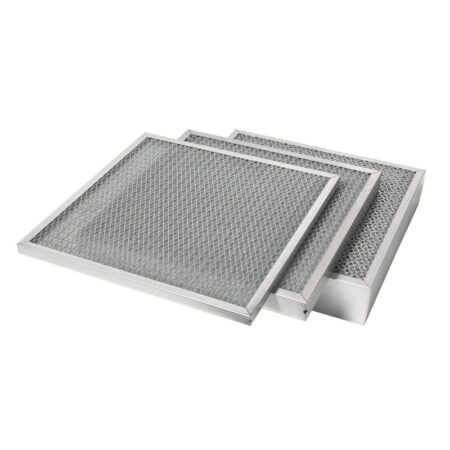
20x20x2 Washable Aluminum Mesh Economizer Filter
$56.88L: 19.5in, W: 19.5in, H: 1.75inAdd to cart -
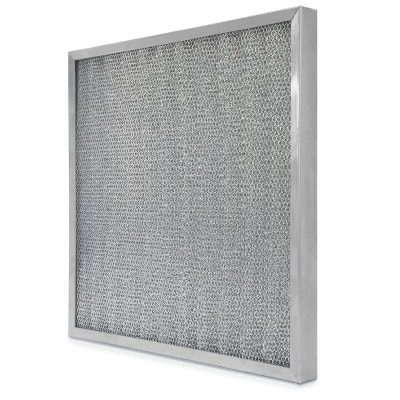
20x25x1 Nominal Economizer Washable Air Filter
$46.54L: 19.5in, W: 24.5in, H: 0.875inAdd to cart -
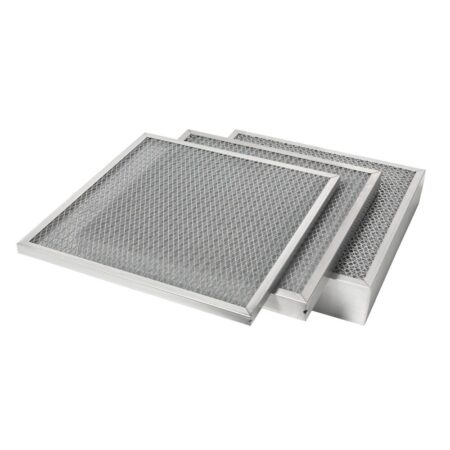
CARRIER KH03DU340 Compatible Aluminum Mesh Filter, 20x20x1
$41.71L: 19.5in, W: 19.5in, H: 0.875inAdd to cart -
TRANE AG0320103 Compatible Aluminum Mesh Filter, 20x20x1
$42.65L: 19.5in, W: 19.5in, H: 0.875inAdd to cart
These four products represent the most commonly ordered economizer filter sizes (20×20×2, 20×25×1, and the Carrier/Trane 20×20 and 20×25 OEM replacements). View the full Carrier, Trane, and York pages for all exact OEM part number matches.
What Is an HVAC Economizer? — How It Works
An HVAC economizer is an energy-saving device integrated into a packaged rooftop unit or air-handling unit that allows the system to use outdoor air as a free cooling source when ambient conditions allow, reducing or eliminating the need for mechanical refrigeration. Understanding how the economizer operates explains why its pre-filter is the highest-duty filtration component in the entire system.
Free Cooling Mode
During mild weather — typically when outdoor dry-bulb temperature is below 55°F–65°F, depending on the control strategy (dry-bulb, enthalpy, differential enthalpy) — the economizer controller opens the outdoor air damper to bring in large volumes of cool, fresh outside air. The supply fan delivers this air directly to the conditioned space without running the compressor, cutting cooling energy consumption by 30–70% during thousands of operating hours per year in temperate climates.
The U.S. Department of Energy estimates that properly functioning economizers reduce commercial building cooling costs by an average of 10–15% annually in climate zones 2 through 5. In coastal California, the Pacific Northwest, and the Great Lakes region, free cooling hours can exceed 2,000 per year, making economizer performance a significant operating cost driver.
The Outside Air Intake and Pre-Filter Position
The outdoor air stream enters through a louvered intake on the side or rear of the rooftop unit. Immediately behind that intake louver — or in a dedicated filter track directly upstream of the economizer damper blade — sits the pre-filter. Every cubic foot of outside air that the economizer processes passes through this single filter. At full economizer mode on a 5-ton unit moving 2,000 CFM, that amounts to 120,000 cubic feet of outdoor air per hour flowing through a filter the size of a single 20×20 panel.
The outdoor air environment is categorically harsher than any recirculated indoor air stream. Outdoor air contains:
- Cottonwood and tree seeds (seasonal, extremely high volume in spring)
- Insects (moths, gnats, small beetles enter at night when the unit runs unattended)
- Pollen — tree, grass, and weed pollen at 2,000–100,000 grains per m³ during peak seasons
- Coarse road and soil dust carried by wind
- Leaves and organic debris from nearby vegetation
- Bird feathers and down in structures near nesting areas
- Industrial particulate in proximity to manufacturing, agriculture, or high-traffic roadways
All of this material accumulates in the economizer pre-filter. When the pre-filter becomes blocked or is absent entirely, every particle proceeds directly to the damper blades (jamming linkages and actuators), the condenser and evaporator coils (fouling fins and reducing heat transfer efficiency), the downstream pleated filters (premature blinding), and the supply fan (blade imbalance). A blocked coil can increase refrigeration energy consumption by 15–40% and require $500–$3,000 in professional coil cleaning or replacement.
Dry-Bulb vs. Enthalpy Control Strategies
Modern economizers use one of three control strategies to determine when to open the outdoor air damper:
| Control Type | Sensor(s) | Opens When… | Common Applications |
| Dry-bulb temperature | Outdoor temperature sensor | Outdoor temp ≤ setpoint (typically 55°F) | Dry climates; ASHRAE 90.1 prescriptive path |
| Fixed enthalpy (single-enthalpy) | Outdoor temperature + humidity sensor | Outdoor enthalpy ≤ setpoint (28 BTU/lb) | Humid climates; ASHRAE 90.1 alternative path |
| Differential enthalpy | Outdoor + return air temp/humidity sensors | Outdoor enthalpy < return air enthalpy | High-end commercial; best energy savings |
Regardless of the control strategy, the economizer operates whenever outdoor conditions qualify — which in most U.S. climate zones means several hundred to several thousand hours per year. Every one of those hours adds to the particle load on the pre-filter.
High-Side vs. Low-Side Economizers
In rooftop units, the economizer may be a high-side configuration (outside air mixed with return air before the cooling coil, the most common design) or a low-side / relief configuration (outside air introduced downstream of the coil on positive-pressure systems). Both designs use the same aluminum mesh pre-filter at the outdoor intake to protect the unit interior. The pre-filter position, slot dimensions, and required thickness are determined by the original equipment manufacturer and are specific to each RTU model family.
Why Economizer Pre-Filters Fail & What It Costs
Economizer pre-filters occupy the highest-volume, highest-contamination air stream in any commercial HVAC system. They receive no protection from upstream filtration — they ARE the upstream filtration. Despite this, many facility maintenance programs treat them as an afterthought: some buildings run them for years without inspection, while others replace an OEM corrugated aluminum mesh filter with a temporary disposable panel that disintegrates within a season.
The Failure Cascade
When an economizer pre-filter becomes loaded beyond its dust-holding capacity, airflow resistance spikes sharply. The supply fan increases electrical draw trying to maintain CFM targets. If the filter is not cleaned, the sequence of failures proceeds in a consistent pattern:
- Filter face velocity drops as resistance builds — the economizer delivers less outdoor air than the control sequence demands, defeating the free-cooling benefit and increasing mechanical cooling run time
- Filter bypass begins — particles find the path of least resistance around a sagging, torn, or misfit filter, and unfiltered air reaches the coil
- Coil fouling accumulates — dust binds to wet fin surfaces, forming an insulating layer that reduces heat transfer efficiency by 10–40%
- Damper blade and actuator fouling — fine debris accumulates on blade pivots and in actuator linkages, causing economizer mode faults that most DDC systems flag as economizer lockout, triggering a service call
- Downstream filter replacement accelerates — with no pre-filtration, the standard MERV 8 or MERV 13 pleated filters inside the unit load at 3–5× their normal rate
Cost of a Neglected Economizer Pre-Filter
| Problem | Typical Repair or Replacement Cost | Preventable With… |
| Coil cleaning (evaporator, fouled) | $350–$900 per RTU (chemical flush + labor) | Annual pre-filter cleaning |
| Coil replacement (if fins corroded or damaged) | $1,200–$4,500 per RTU | Pre-filter + annual coil inspection |
| Economizer actuator replacement (jammed by debris) | $150–$450 parts + labor | Quarterly pre-filter cleaning in high-season areas |
| Downstream MERV 13 filter premature blinding (commercial building) | $45–$120 per bank × 3–6 replacements/year instead of 1–2 | Functional economizer pre-filter |
| Compressor overload from coil fouling | $800–$3,500 per compressor replacement | Pre-filter maintenance + annual coil check |
Washable vs. Disposable Economizer Pre-Filters
OEM manuals for Carrier, Trane, and York all specify a permanent, cleanable aluminum mesh filter at the economizer intake. The reasons are straightforward:
- Disposable filters (cardboard-framed fiberglass or pleated paper) cannot withstand outdoor humidity, rain splash, and temperature swings without deforming and bypassing
- The economizer intake is typically accessible only from the rooftop; a permanent filter that needs cleaning once or twice a year is far more maintainable than a disposable filter that should theoretically be changed monthly
- The aluminum mesh frame is structural — it holds its dimensional integrity through thousands of wash cycles and still fits the factory track without gaps
- UL 900 Class 1 non-combustible construction is required by most commercial HVAC specifications and fire codes for any filter installed in a direct-outside-air path
AMFCO HE Series Economizer Filter Specifications
The HE Series is AMFCO’s purpose-built economizer pre-filter line. Every filter in the series is built to identical media specifications regardless of size, ensuring consistent performance across all unit types and tonnages.
| Specification | Value |
| Media construction | 5-ply corrugated criss-cross aluminum screen wire mesh |
| Frame material | .030-inch thick extruded aluminum alloy channel |
| Face grids | 24-gauge aluminum — both upstream and downstream faces |
| Corner construction | Mitered corners secured with aluminum pop rivets |
| Corner drain holes | 3 drain holes per filter for complete water removal after washing |
| UL certification | UL 900 Class 1 (non-combustible) |
| Continuous service temperature | 275°F (135°C) |
| Atmospheric dust spot efficiency | 53% |
| Dust-holding capacity (2-inch) | 81 g/sq ft |
| Airflow resistance (new, clean) | Very low — ≤0.05 in. w.g. at rated face velocity |
| Service life | 5–10 years with standard cleaning protocol |
| Country of origin | Made in USA by AMFCO (American Air Filter Manufacturing Company) |
All HE Series filters are available in standard sizes (see size reference table below) and can be ordered as custom-cut panels for non-standard economizer openings. When ordering custom sizes, provide the exact nominal outer-frame dimensions and depth; AMFCO cuts to the nearest 1/16-inch for tight-tolerance applications.
-
20x20x2 Washable Aluminum Mesh Economizer Filter
$56.88L: 19.5in, W: 19.5in, H: 1.75inAdd to cart
OEM Part Number Cross-Reference
The table below cross-references original manufacturer part numbers to AMFCO washable aluminum mesh replacements. All AMFCO filters are manufactured to the exact nominal or exact actuals of the OEM specification. Where the OEM specifies a corrugated mesh filter (standard across Carrier, Trane, and York economizer specs), the AMFCO filter meets or exceeds the OEM dust arrestance rating.
Carrier / Bryant Economizer Filter Cross-Reference
| OEM Part Number | Filter Size | Compatible RTU Series | AMFCO Replacement |
| KH03DU267 | 19-1/2 x 19-1/4 x 1/2″ exact | 48HJ, 50HJ ≤5 ton | HIAS050650-1-KH03DU267 |
| KH03DU271 | 19.5 x 19.5 x 1/2″ exact | 48HJ, 50HJ ≤5 ton | HIAS050650-1-KH03DU271 |
| KH03DU320 | 16×20×1″ nominal | 48HJ 7.5–10 ton | HIA101620-1-KH03DU320 |
| KH03DU330 | 16×25×1″ nominal | 48HJ 7.5–10 ton | KH03DU330 |
| KH03DU340 | 20×20×1″ nominal | 50HJ 10–15 ton | HIA102020-1-KH03DU340 |
| KH03DU350 | 20×25×1″ nominal | 50HJ 10–15 ton | HIA102025-1-KH03DU350 |
| KH03DW160 | 8×25 exact | 48HJ small commercial | HIAS100200-1-KH03DW160 |
| KH03DW161 | 8×35 exact | 48HJ small commercial | HIAS100300-1-KH03DW161 |
| KH03HL003 | 16×25×2″ | 50HJ 10–15 ton (2-in track) | HIA201625-1-KH03HL003 |
| KH03HL005 | 20×25×2″ | 50HJ 15–20 ton (2-in track) | HIA202025-1-KH03HL005 |
| 50HJ540574 | 15 x 19–4 exact | 50HJ 5–7.5 ton exact | HIAS100500-1-50HJ540574 |
| 50HJ540575 | 20 x 20–8 exact | 50HJ 10 ton exact | HIAS100800-1-50HJ540575 |
| 50HJ540610 | 20×20×1 nominal | 50HJ 10–12.5 ton | HIA102024-1-50HJ540610 |
| 50HJ540611 | 21 x 20–6 exact | 50HJ 12.5–15 ton | HIAS100700-1-50HJ540611 |
| 48HG503545 | 20×24×1 nominal | 48HG 10–15 ton | HIA102024-1-48HG503545 |
Trane Economizer Filter Cross-Reference
| OEM Part Number | Filter Size | Compatible RTU Series | AMFCO Replacement |
| AG0320101 | 16×20×1″ nominal | Voyager YCD/TCD 7.5–10 ton | HIA101620-1-AG0320101 |
| AG0320102 | 16×25×1″ nominal | Voyager YCD/TCD 10–12.5 ton | HIA101625-1-AG0320102 |
| AG0320103 | 20×20×1″ nominal | Voyager YCD/TCD 12.5–15 ton | HIA102020-1-AG0320103 |
| AG0320104 | 20×25×1″ nominal | Voyager YCD/TCD 15–20 ton | HIA102025-1-AG0320104 |
| AG0320204 | 20×25×2″ | Precedent WCD/WCS 15–20 ton | HIA202025-1-AG0320204 |
| FLR00537 | 20×25×1″ nominal | WeatherMaster CGAF, Precedent YSD | HIA102025-1-FLR00537 |
| FLR06788 | 19 x 60–3/4 exact (large commercial) | WeatherMaster CGAF 20–25 ton | HIAS101250-1-FLR06788 |
| FLR09410 | 23.75 x 29.5 exact | WeatherMaster CGAF 15–20 ton | HIAS100950-1-FLR09410 |
Johnson Controls York Economizer Filter Cross-Reference
| OEM Part Number | Filter Size | Compatible RTU Series | AMFCO Replacement |
| S1-026-08210-000 | 16×25×1″ nominal | Predator ZF/ZH 7.5–10 ton | HIA101625-1-S1-026-08210-000 |
| S1-026-25514-000 | 14×20 exact | Sunline 2000 DJ 5–7.5 ton | HIA101420-1-S1-026-25514-000 |
| S1-026-25535-000 | 12 x 22 exact | Sunline 2000 DJ compact | HIAS100600-1-S1-026-25535-000 |
| S1-026-25557-000 | 19 x 60-3/4 exact (large commercial) | Sunline 2000 / York ZH 20–25 ton | HIAS101250-1-S1-026-25557-000 |
| S1-026-25572-000 | 20 x 20–8 exact | Predator ZF 10–15 ton | HIAS100800-1-S1-026-25572-000 |
| S1-026-38061-000 | 21 x 20–6 exact | Predator ZH 15–20 ton | HIAS100700-1-S1-026-38061-000 |
| S1-026-42507-000 | 19 x 47-3/4 exact (2-inch) | York large commercial 20–25 ton | HIAS200950-1-S1-026-42507-000 |
Part numbers not listed? Use the custom filter form and enter your exact measurements. Many older or discontinued RTU models used non-standard economizer filter dimensions; AMFCO can match any size with exact-actuals tolerances of ±1/16 inch.
Common Economizer Filter Sizes
The table below lists the most frequently ordered nominal and exact-dimension economizer filter sizes. Nominal sizes are industry-standard dimensions (20×20, 20×25, etc.) that fit a range of units from multiple manufacturers. Exact-dimension sizes are precision-cut to specific OEM measurements and typically identified by an OEM service part number.
| Nominal Size | Depth | Typical Applications | Order |
| 16×20×1″ | 1 inch | Carrier 48HJ 7.5–10T, Trane Voyager 7.5–10T | Shop |
| 16×25×1″ | 1 inch | Carrier KH03DU330, Trane AG0320102, York S1-026-08210-000 | Shop |
| 20×20×1″ | 1 inch | Carrier 50HJ/48HJ 10T, Trane Voyager 12.5T (most common size) | Shop |
| 20×20×2″ | 2 inch | HE Series 20×20×2 (HEA202020) — extended dust-holding | Shop |
| 20×24×1″ | 1 inch | Carrier 48HG503545 | Shop |
| 20×25×1″ | 1 inch | Trane AG0320104, FLR00537; York; Carrier KH03DU350 — second most common size | Shop |
| 20×25×2″ | 2 inch | Trane AG0320204, Precedent WCD/WCS 2-inch track | Shop |
| Custom exact-dimension | 1/2″, 3/4″, 1″, 2″ | Any OEM exact-dimension specification not listed above | Custom Order |
Every size listed is in stock for immediate shipment. For sizes not listed, use the custom filter form to specify your exact outer dimensions and depth.
Economizer Filter Usage Across the Commercial HVAC Industry
HVAC economizers are required by code in most U.S. commercial construction. ASHRAE Standard 90.1-2019 requires economizers on all packaged HVAC systems with cooling capacity ≥6,000 BTU/h (0.5 ton) in climate zones 1B through 8. Virtually every commercial packaged rooftop unit installed in the U.S. since 2010 includes an economizer. The following estimates show the scale of the economizer pre-filter market and the number of unit families for which AMFCO manufactures compatible replacements.
| RTU Manufacturer | Est. North American Installed Base¹ | Economizer Unit Families Covered | AMFCO Filters Available |
| Carrier / Bryant | >1.5 million commercial RTUs | 48HJ, 50HJ, 48HG, 50XC — 15+ model families | 15 OEM part numbers + custom cuts |
| Trane (Ingersoll Rand) | >1.2 million commercial RTUs | Voyager YCD/TCD, Precedent YSD/WCD, WeatherMaster CGAF — 10+ model families | 8 OEM part numbers + custom cuts |
| Johnson Controls York | >900,000 commercial RTUs | Predator ZF/ZH, Sunline 2000 DJ, large commercial ZH — 8+ model families | 7 OEM part numbers + custom cuts |
| Lennox International | >600,000 commercial RTUs | Landmark LGH/LCH, LRP Rooftop — 6+ model families | Custom cut to spec |
| Daikin Applied / McQuay | >400,000 commercial AHUs + RTUs | Commercial AHU, Magnitude, applied packaged — 5+ families | Custom cut to spec |
| Goodman / Amana (Daikin) | >500,000 commercial RTUs | GPC, GSC, GSZC series | Custom cut to spec |
| Aaon | >200,000 commercial RTUs | RN, RQ, OH, V3 series — known for large economizer sections | Custom cut to spec |
| OEMs served by custom cut | Tens of thousands of legacy and specialty units | Mammoth, Reznor, Nortek, source-specific commercial AHUs | Any size, ±1/16″ tolerance |
¹ Estimates based on publicly available industry data and product-family documentation; not an official manufacturer figure.
When you combine the installed base across the top three brands alone — Carrier, Trane, and York — there are more than 3.6 million commercial rooftop units across North America that use an aluminum mesh economizer pre-filter. Each unit requires cleaning or replacement of that filter at least once per year, and many facilities have multiple RTUs on a single roof. AMFCO’s HE Series and exact-dimension OEM replacements address the full service lifecycle of the largest installed base in the commercial HVAC market.
Tonnage and Unit Count Impact
A typical commercial building in the 10,000–50,000 sq ft range — a strip mall, K–12 school, restaurant chain, hotel, or mid-size office building — has between 2 and 10 rooftop units, each with one or two economizer pre-filter slots. A national retail chain with 500 locations and an average of 4 RTUs per site has 2,000 economizer pre-filters that require annual maintenance. At an OEM replacement cost of $30–80 per filter, that is $60,000–$160,000 per year in filter procurement alone. Replacing those filters with washable AMFCO panels, cleaned in place during routine PM visits, eliminates that recurring cost entirely.
How to Identify Your Economizer Filter Size
Most facility managers encounter economizer pre-filters for the first time when a service technician notes a damaged or missing filter during preventive maintenance. The following procedure identifies the correct replacement filter in under two minutes.
Method 1: OEM Part Number Lookup
The service label inside the RTU access panel or the unit nameplate contains the model number. Use your RTU model number to look up the correct economizer filter part number in the unit’s installation and maintenance guide (available on the manufacturer’s service portal). Match the OEM part number against the cross-reference tables above, or enter it in our Carrier, Trane, or York filter pages.
Method 2: Direct Measurement
If the existing filter is accessible, measure the outer frame dimensions: length, width, and depth. Record measurements to the nearest 1/8 inch. If the filter has been removed or is not present, measure the filter track (slot) inside the unit, noting any lips or retaining tabs that reduce the usable opening by 1/4–1/2 inch per side. This is the most reliable method for legacy units or units whose service documentation is unavailable.
| What You Measure | How to Use It |
| Outer frame: full length × width × depth | Match against the size reference table above or enter in the custom filter form |
| Filter track clear opening | Add 1/4″ on each side to get the nominal frame dimension (standard installation clearance) |
| Existing filter depth | 1/2″, 3/4″, 1″, and 2″ are the standard depths; confirm the filter track can accept the depth you order |
Method 3: Use Our Custom Filter Form
Enter your exact outer dimensions and depth in the custom air filter configurator. AMFCO will cut the filter to your specified dimensions with ±1/16-inch tolerance, using the same five-ply aluminum mesh media and extruded aluminum frame as the standard HE Series. This is the recommended path for exact-dimension OEM filters not listed in the tables above, or for non-standard economizer openings found on older or specialty RTU installations.
Cleaning and Maintenance Schedule for Economizer Pre-Filters
The correct maintenance interval for an economizer pre-filter depends on the ambient environment, the proximity of vegetation (cottonwood, trees), traffic, and the number of economizer operating hours per year. The following schedule is a baseline for most North American commercial locations.
| Environment | Recommended Cleaning Interval | Inspection Interval |
| Standard commercial (office, retail, light industrial) | Every 6 months — spring and fall | Every 3 months |
| High-pollen (cottonwood belt, heavy tree cover, agriculture) | Monthly during spring/early summer + every 3 months off-season | Monthly during growing season |
| High-dust (near unpaved roads, construction, agricultural) | Monthly or as required | Bi-weekly during active periods |
| Urban core (heavy traffic, exhaust particulate) | Every 3–4 months | Monthly |
| Coastal (salt air) | Every 3 months — inspect for aluminum oxidation | Monthly; inspect for corrosion |
Cleaning Procedure
- Shut down the RTU or isolate the economizer damper before removing the filter to avoid drawing unfiltered air into an operating system
- Remove the filter from its track; note the airflow arrow direction so the filter is reinstalled correctly
- Take the filter to the roof edge or a suitable work area away from the intake to prevent loosened debris from re-entering the unit
- Brush away dry debris — use a stiff nylon brush or compressed air (low pressure) to dislodge loose material from the upstream face
- Rinse with water from the clean (downstream) side outward (backwash) to flush particles out through the upstream face without packing them deeper into the mesh
- Apply mild detergent for heavy soiling; let it dwell 5–10 minutes, then scrub lightly with a nylon brush
- Rinse thoroughly until water runs clear
- Shake off excess water and allow to air-dry completely before reinstalling. Wet filters can wick moisture into the unit, promoting microbial growth on the downstream coil
- Reinstall with the airflow arrow pointing toward the blower and confirm the filter seats fully in its track with no air bypass gaps at the edges
Frequently Asked Questions: Economizer Filters
What is an economizer filter?
An economizer filter (also called an economizer pre-filter) is a washable aluminum mesh screen installed at the outside-air intake of a commercial rooftop unit’s economizer section. Its purpose is to capture coarse outdoor particulate — pollen, cottonwood, insects, dust, and debris — before that air reaches the economizer damper, heating and cooling coil, and downstream high-efficiency filters. Most commercial RTU manufacturers specify a permanent, cleanable aluminum mesh filter for this position rather than a disposable panel.
How often should an economizer filter be replaced?
A washable aluminum mesh economizer filter does not need to be replaced on a fixed schedule — it needs to be cleaned. Most commercial facilities clean their economizer pre-filters twice per year (spring and fall). In high-pollen environments or locations near cottonwood trees, monthly cleaning during spring is advisable. With routine cleaning, a quality aluminum mesh economizer filter lasts 5–10 years before requiring replacement.
What size is a Carrier economizer filter?
Carrier rooftop units use several different economizer filter sizes depending on the unit model and tonnage. The most common nominal sizes are 20×20×1 (KH03DU340), 20×25×1 (KH03DU350), and 16×20×1 (KH03DU320). Many Carrier economizer filters are exact-dimension (non-nominal) sizes identified by service part numbers beginning with KH03DU, KH03HL, KH03DW, 50HJ540, or 48HG503. See the Carrier filter cross-reference table above or visit the Carrier economizer filters page to find your specific part number.
What size is a Trane economizer filter?
Trane rooftop unit economizer filters are identified by part numbers in the AG0320xxx or FLR-prefix families. Common nominal sizes include 16×20×1 (AG0320101), 20×20×1 (AG0320103), and 20×25×1 (AG0320104 / FLR00537). Larger units (WeatherMaster CGAF) use exact-dimension filters up to 19×60-3/4 in size. Visit the Trane economizer filters page for the complete cross-reference.
Are economizer filters the same as furnace filters?
No. Economizer pre-filters and furnace or air-handler filters serve different purposes and occupy different positions in the air stream. An economizer pre-filter is located at the outdoor air intake and is exposed to 100% outdoor (unfiltered) air at high face velocities and in outdoor temperature and humidity conditions. A furnace filter is installed in the return air path, handling recirculated indoor air. Economizer pre-filters are always specified as permanent aluminum mesh (non-combustible, weatherproof); furnace filters range from MERV 4 disposable to MERV 16 bag filters.
Can I use a disposable filter as an economizer pre-filter?
No — and OEM service manuals for Carrier, Trane, and York explicitly specify a permanent, cleanable aluminum mesh filter at the economizer intake. A cardboard-framed fiberglass or paper-pleated disposable filter will deform in outdoor weather exposure, lose structural integrity in rain or high humidity, and fail to hold its dimension in the filter track, creating bypass gaps. Additionally, most local fire codes and ASHRAE 90.1 require UL 900 Class 1 non-combustible construction for filters installed in a direct outdoor air path, which disposable fiberglass and paper filters do not meet.
What MERV rating is an economizer filter?
Economizer pre-filters are typically MERV 1–2 (aluminum mesh) or MERV 4 (foam-plus-mesh). They are not designed to be high-efficiency filters — their purpose is to remove coarse particulate (insects, pollen, cottonwood, large debris) while maintaining the very low pressure drop required at outdoor air face velocities. High-efficiency filtration (MERV 8+ or MERV 13) is provided by the downstream filters installed in the unit’s main filter bank, not at the economizer intake.
Do all rooftop units have economizer filters?
In the United States, most commercial rooftop units installed since 2010 include an integrated economizer, and therefore have a pre-filter slot at the outdoor air intake. ASHRAE Standard 90.1 requires economizers on commercial systems ≥0.5 ton in most climate zones, covering the vast majority of commercial buildings. Residential and light commercial mini-split systems, window units, and PTAC units do not have economizers. Older commercial buildings with pre-2004 rooftop units may have economizer-capable units that have not been retrofitted with functional economizer controls, but that still have pre-filter tracks that require attention.
How do I know if my economizer filter needs cleaning?
A visual inspection is the most reliable method. Remove the filter and hold it up to a light source: if you cannot see light through the aluminum mesh, the filter needs cleaning. Other indicators include reduced supply airflow from the system (measured by a reduction in CFM at diffusers or via DDC reporting), increased static pressure across the economizer section, and in extreme cases, a visible buildup of debris visible from outside the unit intake louver.
What is the difference between a nominal and an exact-dimension economizer filter?
A nominal filter (e.g., 20×20×1) uses standard industry dimensions that are slightly smaller than the stated size — a nominal 20-inch filter measures approximately 19-3/4 inches actual. Nominal filters fit a wide range of industrial and commercial filter tracks and are interchangeable across brands that use standard slot dimensions. An exact-dimension filter (identified by OEM part numbers like KH03DU267 or S1-026-25514-000) is precision-cut to specific measurements that may include fractional inches (e.g., 19-1/2× 19-1/4×1/2). These exact filters fill non-standard economizer openings entirely, preventing bypass air around the filter edges. Both types are available from AMFCO.
Related Filter Categories
Economizer pre-filters are one application in a broader family of washable metal air filters. Related categories:
- Aluminum Screen Air Filters — HI Series — the specific media type used in most OEM economizer pre-filters; includes HIA, HIG, and HIS material variants and custom sizing
- Metal Mesh Air Filters — full metal mesh filter guide covering all mesh media types
- Washable Metal Air Filters — when a higher-MERV washable filter is needed for the same return-air or mixed-air opening