Washable stainless steel mesh air filters are multi-ply corrugated Type 304 stainless steel media filters designed for applications where aluminum is not suitable: high-temperature industrial process ventilation, corrosive environments including coastal and marine installations, food and pharmaceutical process air systems, spray and paint booths, chemical plant make-up air, and any application where the air stream carries materials that attack aluminum or galvanized coatings. The Type 304 stainless steel construction is rated for continuous operation to 1,000°F — more than three times the temperature ceiling of our aluminum mesh filters — and is dimensionally stable across the full temperature range without oxidation, coating degradation, or media pack delamination.
Metal Air Filters has manufactured washable stainless steel mesh filters in the USA since 1986, using the same multi-ply corrugated media construction as our HI Series aluminum filters but fabricated entirely from Type 304 stainless steel alloy: media pack, face grids, and frame. Available in standard nominal sizes from 12×24 through 24×24 in 1”, 2”, and 4” depths, and in custom-fabricated dimensions to any exact specification. UL 900 Class 1 rated. Free shipping on orders over $99.
Shop Washable Stainless Steel Mesh Filters
-
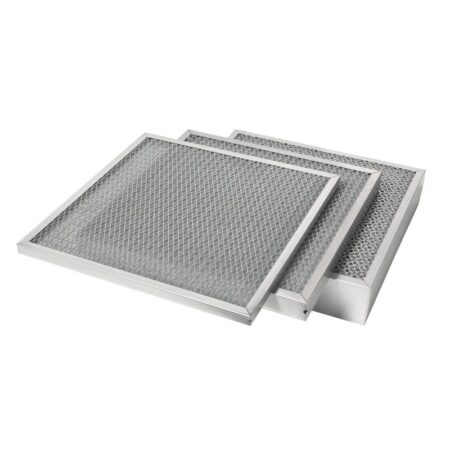
12x24x1 Washable Stainless Steel Mesh Filter
$71.15L: 11.5in, W: 23.5in, H: 0.875inAdd to cart -
16x20x2 Washable Stainless Steel Mesh Filter
$101.66L: 15.5in, W: 19.5in, H: 1.75inAdd to cart -
16x20x4 Washable Stainless Steel Mesh Filter
$135.98L: 15.5in, W: 19.5in, H: 3.75inAdd to cart -
16x25x2 Washable Stainless Steel Mesh Filter
$120.12L: 15.5in, W: 24.5in, H: 1.75inAdd to cart -
20x20x1 Washable Stainless Steel Mesh Filter
$91.90L: 19.5in, W: 19.5in, H: 0.875inAdd to cart -
20x20x2 Washable Stainless Steel Mesh Filter
$119.78L: 19.5in, W: 19.5in, H: 1.75inAdd to cart -
20x20x4 Washable Stainless Steel Mesh Filter
$158.49L: 19.5in, W: 19.5in, H: 3.75inAdd to cart -
20x25x1 Washable Stainless Steel Mesh Filter
$109.08L: 19.5in, W: 24.5in, H: 0.875inAdd to cart -
20x25x2 Washable Stainless Steel Mesh Filter
$142.29L: 19.5in, W: 24.5in, H: 1.75inAdd to cart -
24x24x1 Washable Stainless Steel Mesh Filter
$121.94L: 23.5in, W: 23.5in, H: 0.875inAdd to cart -
24x24x2 Washable Stainless Steel Mesh Filter
$159.10L: 23.5in, W: 23.5in, H: 1.75inAdd to cart -
24x24x4 Washable Stainless Steel Mesh Filter
$207.23L: 23.5in, W: 23.5in, H: 3.75inAdd to cart
Product Overview — What Are Washable Stainless Steel Mesh Filters?
A washable stainless steel mesh filter uses the same fundamental construction as our aluminum mesh filters — corrugated metal media plies bonded between rigid face grids inside a mitered, pop-riveted frame — but built entirely from Type 304 stainless steel alloy throughout. The media pack is 5-ply in the 1” depth, 7-ply in the 2” depth, and 9-ply in the 4” depth, providing progressively higher dust arrestance and holding capacity as depth increases. The corrugated geometry creates a tortuous airflow path that captures coarse particulate — dust, grit, pollen, fiber, and aerosol droplets — by inertial impaction, while the open metal structure maintains low and stable airflow resistance throughout the service cycle.
Where a stainless steel filter differs from aluminum is in the performance envelope at its extremes. Aluminum alloy mesh filters are rated to 275°F continuous service — appropriate for the vast majority of commercial and residential HVAC applications where supply and return air temperatures never approach that ceiling. Type 304 stainless steel filters are rated to 1,000°F continuous service, which covers industrial process ventilation, kiln and oven exhaust pre-filtration, and high-temperature make-up air applications that would destroy an aluminum filter within a short service period. Stainless also resists oxidation, pitting, and crevice corrosion in environments that attack aluminum: salt air near coastlines, chlorine-bearing chemical environments, and high-humidity industrial processes where condensation accelerates alloy degradation.
The filtration efficiency profile is identical to aluminum mesh across the same depths: MERV 4–5 equivalent arrestance, suitable for equipment protection against coarse particulate. Stainless steel mesh filters are not high-MERV filtration devices — they do not capture fine particles, smoke, or sub-micron aerosols. Their purpose is to protect downstream equipment (coils, heat exchangers, fans, motors) from the coarser grain size fraction of whatever the air stream carries, while providing the extended service life and low pressure-drop consistency that only a washable metal media can deliver.
Because stainless steel is significantly denser than aluminum (approximately 8.0 g/cm³ vs 2.7 g/cm³), a stainless steel filter of the same face area and depth will weigh roughly three times as much as the equivalent aluminum filter. This does not affect filtration performance but is a practical consideration for large-format filters installed in overhead or vertical positions: the heavier frame requires secure retaining hardware and should be verified to seat fully in the slot before the access panel is closed.
Technical Specifications
All HIA Series washable stainless steel mesh filters are manufactured to the following specifications.
| Specification | Value |
|---|---|
| Media material | Multi-ply corrugated Type 304 stainless steel mesh |
| Media plies — 1” depth | 5-ply corrugated construction |
| Media plies — 2” depth | 7-ply corrugated construction |
| Media plies — 4” depth | 9-ply corrugated construction |
| Face grid material | Type 304 stainless steel, bonded both sides |
| Frame material | Type 304 stainless steel alloy |
| Frame construction | Mitered corners, pop-riveted |
| Dimensional tolerance | ±1/16” on all face dimensions |
| UL rating | UL 900 Class 1 |
| Maximum continuous temperature | 1,000°F (538°C) |
| Dust arrestance (ASHRAE 52.1) — 1” | 43% |
| Dust arrestance (ASHRAE 52.1) — 2” | 53% |
| Dust arrestance (ASHRAE 52.1) — 4” | 62% |
| Approximate MERV equivalent | MERV 4–5 (coarse particulate protection) |
| Recommended service interval | 60–90 days (standard duty); inspect more frequently in high-load environments |
| Service life | 10+ years with regular cleaning |
| Country of manufacture | USA (Metal Air Filters, since 1986) |
Available Sizes — Stainless Steel Mesh Filter Reference
Stainless steel mesh filters are available in the nominal sizes listed below. Actual physical dimensions are approximately 1/2” less than nominal on each face dimension to allow for slot clearance. The 1” depth is available in four standard nominal sizes; the 2” and 4” depths are available in six standard nominal sizes. Custom fabrication is available for any face dimension and depth not listed.
| Nominal Size | 1” Depth | 2” Depth | 4” Depth |
|---|---|---|---|
| 12 × 24 | Shop 1” | Shop 2” | Shop 4” |
| 16 × 20 | — | Shop 2” | Shop 4” |
| 16 × 25 | — | Shop 2” | Shop 4” |
| 20 × 20 | Shop 1” | Shop 2” | Shop 4” |
| 20 × 25 | Shop 1” | Shop 2” | Shop 4” |
| 24 × 24 | Shop 1” | Shop 2” | Shop 4” |
| Custom dimensions | Custom 1” | Custom 2” | Custom 4” |
Need a size not listed? We fabricate custom stainless steel mesh filters to any exact face dimension and depth — browse custom filter options or contact us with your measurements for a same-day quote.
Applications for Stainless Steel Mesh Filters
Stainless steel mesh filters are the correct choice when the operating environment exceeds the capabilities of aluminum or galvanized steel. The table below lists the most common applications and the rationale for specifying stainless over other alloys.
| Application | Typical Depth | Why Stainless? |
|---|---|---|
| Industrial process exhaust ventilation (kilns, ovens, curing lines) | 2” or 4” | Air temperatures exceeding 275°F; aluminum media would degrade and delaminate within weeks |
| Coastal and marine HVAC (ocean-facing equipment, offshore platforms, shipboard) | 1” or 2” | Salt air causes pitting corrosion on aluminum and zinc coating failure on galvanized within one to two seasons |
| Food and beverage processing plant ventilation | 1” or 2” | Type 304 stainless is food-grade compatible; aluminum alloys and galvanized coatings are not acceptable under USDA/FDA facility guidelines in many food contact or near-contact air zones |
| Pharmaceutical and cleanroom make-up air pre-filtration | 1” or 2” | Stainless steel is the standard pre-filter material in GMP-regulated facilities; aluminum and coated metals introduce contamination risk under cleaning and sanitizing protocols |
| Spray booth and paint booth exhaust | 2” or 4” | Solvent-bearing air streams attack aluminum oxide layers; stainless resists solvent exposure and is chem-resistant to common coating materials |
| Chemical plant and refinery process ventilation | 2” or 4” | Hydrocarbon vapors, chlorine, and acid gases accelerate aluminum corrosion; stainless provides stable performance across a wide range of chemical exposures |
| Welding fume extraction pre-filter | 1” or 2” | Welding generates high-temperature particulate; near-arc temperatures and metal oxide particulate load require a high-temperature, non-reactive pre-filter media |
| Commercial kitchen Type I exhaust hood (grease pre-filter) | 2” | Grease-laden air, frequent high-pressure washdown cycles, and open flame proximity all favor stainless over aluminum; also required by many commercial kitchen hood manufacturers and local fire codes |
| Make-up air units (MUA) in corrosive industrial environments | 1” or 2” | Outdoor air intake for industrial processes often carries airborne chemicals or salt that attacks aluminum intake filters within the first year of service |
| High-humidity industrial and agricultural ventilation | 1” or 2” | Continuous moisture condensation on the filter face causes corrosion on aluminum and zinc alloys; stainless maintains structural integrity and mesh geometry through wet-dry cycles |
Selecting the Right Filter Depth
Stainless steel mesh filters are available in three depths — 1”, 2”, and 4” — and the choice between them is determined by two factors: the filter slot depth in your equipment, and the required dust holding capacity for your service interval.
1-Inch Depth
The 1” depth fits standard residential return air filter slots, light-commercial AHU filter sections, and commercial rooftop unit filter rails specified for 1” filters. It is the most common depth across our standard catalog. The 5-ply media construction delivers 43% dust arrestance (ASHRAE 52.1) with a low clean pressure drop. Service intervals of 60–90 days are typical for standard HVAC duty; more frequent cleaning is required in high-dust or high-load industrial environments.
2-Inch Depth
The 2” depth is the standard choice for heavier-duty commercial and industrial applications where greater dust holding capacity is needed — economizer filter rails on RTUs, industrial make-up air units, and applications where cleaning intervals must be extended due to access difficulty. At 7 plies and 53% dust arrestance, the 2” depth holds approximately 42% more dust than the 1” depth before reaching the same saturation level, effectively extending the cleaning interval for equivalent airborne load conditions.
4-Inch Depth
The 4” depth is specified for demanding industrial applications: high-temperature process ventilation where particulate load is heavy and cleaning access is infrequent, deep-slot filter housings in large AHUs, and applications where maximum arrestance and dust holding capacity are required from a washable pre-filter stage. The 9-ply media construction at 4” achieves 62% dust arrestance — the highest in the stainless steel mesh product line. These filters are substantially heavier than the 1” and 2” variants; ensure the filter housing is rated for the weight and that retaining hardware is secure before installation.
Installation Instructions
Installation of a washable stainless steel mesh filter follows the same general procedure as any metal mesh filter. The key differences from aluminum installation are weight and, in high-temperature applications, thermal expansion considerations.
Before You Begin
- Confirm the nominal filter size matches your filter slot before proceeding. A stainless steel filter is significantly heavier than an aluminum filter in the same size — verify that the housing retaining rail or tab can support the weight.
- For high-temperature applications: allow the equipment to cool to below 200°F before installing or removing filters. A filter that is seated in a slot at ambient temperature will expand slightly at operating temperature; ensure the slot dimensions allow for this with a minimum 1/16” clearance on each dimension.
- Turn the system off before opening the filter access panel. In industrial applications with continuous-duty fans, follow your site’s lockout/tagout (LOTO) procedure before accessing the filter housing.
Step-by-Step Filter Installation
- Open the filter access panel. For commercial AHU or industrial filter housings, this is typically a hinged access door secured by wing nuts or quarter-turn latches. On residential systems, the filter is accessed via a removable panel at the blower inlet or through the return air grille.
- Remove the existing filter. Stainless steel filters in high-temperature applications can accumulate hard-baked particulate that bonds the frame to the slot walls; a firm straight pull is usually sufficient to break the seal. Do not pry or bend the frame.
- Inspect the slot and retaining hardware. In high-temperature or corrosive environments, check the slot rails and retaining tabs for corrosion or deformation. The filter frame must seat cleanly on all four sides without rocking or gaps. Clean any loose scale or debris from the slot before installing the new filter.
- Check airflow direction arrows. The filter should be installed with the media face toward the incoming air. In most industrial and commercial makes-up air applications this means the filter faces the outdoor air intake, with the downstream side facing the fan section.
- Slide the filter into the slot. Guide it straight in along the rail or slot walls. The frame should slide with light resistance — not loose (creating bypass gaps) and not binding (indicating the filter is oversized for the slot). Seat it flush with all four edges contacting the slot frame.
- Secure and close the access panel. Restore power per your site’s startup procedure. Verify normal fan operation noise — a significant change in blower sound can indicate a partially blocked or unseated filter.
Cleaning and Maintenance
Washable stainless steel mesh filters are cleaned using the same procedure as aluminum mesh filters, with additional considerations for high-temperature applications and chemically contaminated air streams.
Standard Cleaning Procedure
- Remove the filter from the slot per the installation instructions above. Allow it to cool completely before handling if it has been operating in a high-temperature application.
- Take it to a safe wash area. In industrial environments, follow your facility’s procedures for handling contaminated filter media — grease, chemical residue, or metal oxide particulate may require specific disposal or rinse water management protocols.
- Rinse with a garden hose or pressure washer, spraying in the direction opposite to normal airflow to flush captured particulate out of the media channels. Type 304 stainless steel can be pressure-washed at full pressure without damage to the media pack or frame.
- For grease, oil mist, or heavy industrial contamination: apply a degreasing agent (dish soap, citrus degreaser, or an appropriate industrial cleaner compatible with stainless steel — avoid chlorinated cleaners, which can cause chloride stress corrosion on Type 304). Work the degreaser into the media with a brush, then rinse thoroughly in both directions until the water runs clear.
- Inspect the frame and media while the filter is wet — any deformation, cracking, or media pack separation is more visible when wet. Type 304 stainless steel mesh filters that have been in high-temperature service should be inspected for discoloration (blue-black heat tinting is normal and does not affect performance) and for any evidence of weld point cracking at the frame miters.
- Reinstall after shaking out excess water. In standard HVAC applications, residual moisture evaporates within minutes of startup. In high-temperature applications, a brief ambient air-dry reduces steam generation when the filter first re-enters service at operating temperature.
Cleaning frequency: Standard HVAC applications — every 60 to 90 days. Industrial high-load environments (heavy particulate, oil mist, process exhaust) — inspect monthly and clean when visible loading or measurable pressure drop increase is present. High-temperature applications — inspect at each scheduled maintenance access; baked-on particulate is significantly more difficult to remove if cleaning is deferred too long.
Frequently Asked Questions
What makes stainless steel mesh filters different from aluminum mesh filters?
The alloy and its properties. Filtration performance — arrestance, pressure drop, dust holding capacity — is essentially identical for the same media ply configuration. The differences are: (1) Temperature rating: stainless steel is rated to 1,000°F vs 275°F for aluminum. (2) Corrosion resistance: Type 304 stainless resists salt air, chlorine, acids, and many solvents that attack aluminum alloys and galvanized coatings. (3) Weight: stainless is approximately three times heavier than aluminum at equivalent dimensions. (4) Cost: stainless is a higher-cost alloy with higher fabrication cost — expect stainless filters to cost 50–80% more than equivalent aluminum.
What temperature can a stainless steel mesh filter withstand?
Our HIA Series stainless steel mesh filters are rated for continuous service to 1,000°F (538°C). This is a continuous operating temperature rating, not a peak or intermittent rating. At operating temperatures above 800°F, the stainless steel will develop a characteristic blue-black heat tinting (oxidation discoloration) on the media and frame — this is a cosmetic effect and does not affect the structural integrity or filtration performance of the filter. If you are operating above 1,000°F, contact us — alternative alloys (type 310 SS, inconel) may be applicable.
Are stainless steel mesh filters suitable for food processing environments?
Type 304 stainless steel is a food-grade compatible material and is the standard alloy specification for food-contact and food-adjacent equipment under USDA and FDA facility guidelines. Stainless steel mesh filters in food processing ventilation are appropriate from a material safety standpoint. That said, the specific regulatory requirements for filter media in a given food processing environment depend on your facility’s HACCP plan and any applicable third-party auditing standards (SQF, BRC, etc.) — consult with your food safety compliance team before installing any filter type in a regulated zone.
Can I use a stainless steel filter in a coastal or marine environment?
Yes, and this is one of the primary applications for stainless steel over aluminum in HVAC. Type 304 stainless steel is highly resistant to salt air corrosion. Aluminum alloys exposed to marine-grade salt air develop surface oxidation and pitting within one to two seasons; galvanized zinc coatings fail even faster. A stainless steel filter in coastal or marine HVAC will outlast aluminum by a factor of 5 to 10 in typical ocean-proximity installations. For extreme marine exposure (offshore platforms, shipboard), or where the air stream carries high-concentration salt spray rather than ambient salt air, Type 316 stainless may be preferable — contact us to discuss.
Can I clean stainless steel mesh filters with a pressure washer?
Yes. Type 304 stainless steel is fully compatible with pressure washing at standard residential and commercial pressure washer output (1,500–3,000 PSI). Unlike aluminum mesh, there is no risk of frame distortion from pressure washing at medium pressure. Avoid using chlorinated cleaning agents (including bleach and some industrial degreasers containing sodium hypochlorite) — chloride ions are a known cause of chloride stress corrosion cracking in Type 304 stainless, particularly at elevated temperatures. Use a chloride-free degreaser for heavy industrial contamination.
Why are stainless steel filters more expensive than aluminum?
Two reasons: material cost and fabrication cost. Type 304 stainless steel sheet stock costs roughly 3–4 times as much as equivalent aluminum alloy sheet per pound. Because stainless is also denser, a filter of the same face dimensions requires more material mass. Fabrication (cutting, corrugating, bonding) is also more demanding for stainless than aluminum. Stainless steel filters are the correct choice when the operating environment requires them — in those applications, the higher unit cost is justified by the extension in service life and the elimination of corrosion-driven replacement cycles.
What nominal sizes are available in stainless steel?
Stock stainless steel mesh filters are available in 12×24, 16×20, 16×25, 20×20, 20×25, and 24×24 nominal face dimensions. The 12×24, 20×20, 20×25, and 24×24 sizes are stocked in all three depths (1”, 2”, and 4”). The 16×20 and 16×25 sizes are available in 2” and 4” depths only — not the 1” depth in stainless. Custom fabrication covers any size and depth not in stock.
Can I get a custom size stainless steel filter?
Yes. We fabricate custom stainless steel mesh filters to any exact face dimension and depth — same as our aluminum mesh custom product line. Contact us with your measurements (width × height × depth to the nearest 1/16”) and we will quote same business day. Custom stainless steel filters are particularly common in industrial and commercial applications where filter openings are application-specific dimensions, not standard nominal sizes. Browse our custom filter configurator for self-service ordering.
Are your stainless steel filters made in the USA?
Yes. All Metal Air Filters products, including the full stainless steel mesh filter line, are manufactured in the USA at our facility operating since 1986. We source Type 304 stainless steel sheet stock domestically and fabricate the corrugated media, face grids, and frame assembly in-house. We do not import or relabel overseas-manufactured stainless steel filters. USA manufacture means we control the alloy certification, the media geometry, and the dimensional tolerances on every filter we ship.
Metal Air Filters has manufactured washable stainless steel mesh filters in the USA since 1986. Our HIA Series stainless steel filters are available in standard nominal sizes from 12×24 through 24×24 in 1”, 2”, and 4” depths, and in custom-fabricated dimensions for any non-standard application. Free shipping on orders over $99. Custom filter quotes are turned around same business day — contact us with your dimensions to get started, or browse our custom filter configurator.